


Trigonometry for Game Programming: Part 1/2
Learn Trigonometry for Game Programming in this 2-part tutorial series, where you’ll learn the theory and then practice by making a space shooter game! By Matthijs Hollemans.
Learn Trigonometry for game programming!

Learn Trigonometry for game programming!
This is a post by iOS Tutorial Team member Matthijs Hollemans, an experienced iOS developer and designer. You can find him on Google+ and Twitter.
Does the thought of doing mathematics give you cold sweats? Are you ready to give up on your career as a budding game developer because the math just doesn’t make any sense to you?
Don’t fret – math can be fun, and this cool 2-part game tutorial will back up that claim!
Here’s a little secret: as an app developer, you don’t really need to know a lot of math. If you can add or multiply two numbers together, you’re already halfway there. Most of the computations that we do in our professional lives don’t go much beyond basic arithmetic.
That said, for making games it is useful to have a few more math skills in your toolbox. You don’t need to become as smart as Archimedes or Einstein, but a basic understanding of trigonometry, combined with some common sense, will take you a long way.
In this tutorial, you will learn about some important trigonometric functions and how you can use them in your games. Then you’ll get some practice applying the theories by developing a simple spaces shooter iPhone game that requires a lot of trigonometry, using the Cocos2D game framework.
Don’t worry if you’ve never used Cocos2D before or are going to use a different framework for your game – the mathematics we’ll cover in this tutorial will apply to your engine no matter what. And you don’t need any prior experience, as I’ll walk through the process step-by-step.
If you supply the common sense, this tutorial will get you up to speed on the trig, so let’s get started!
Getting Started: It’s All About Triangles
It sounds like a mouthful, but trigonometry simply means calculations with triangles (that’s where the tri comes from).
You may not have realized it until now, but games are full of triangles. For example, imagine you have a spaceship game, and you want to calculate the distance between these ships:
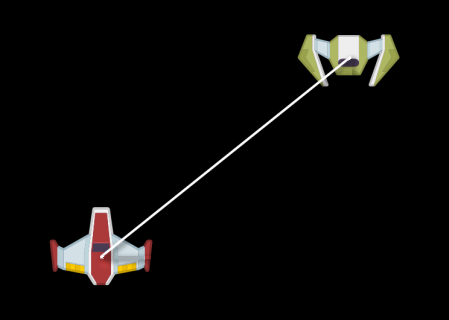
You have X and Y position of each ship, but how can you find the length of that line?
Well, you can simply draw a line from the center point of each ship to form a triangle like this:
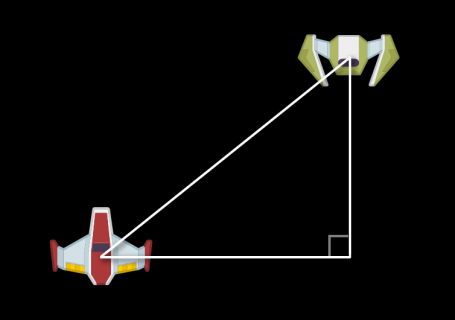
Then, since you know the X and Y coordinates of each ship, you can compute the length of each of the new lines. Now that you know the lengths of two sides of the triangle, you can use some Trigonometry to compute the length of the diagonal line – the distance between the ships.
Note that one of the corners of this triangle has an angle of 90 degrees. This is also known as a right triangle, and that’s the sort of triangle you’ll be dealing with in this tutorial.
Any time you can express something in your game as a triangle with a 90-degree right angle – such as the spatial relationship between the two sprites in the picture – you can use trigonometric functions to do calculations on them.
So in summary, Trigonometry is the mathematics that you use to calculate the lengths of the sides of these triangles, as well as the angles between those sides. And that comes in handy more often that you might think.
For example, in this space ship game you might want to:
- Have one ship shoot a laser in the direction of the other ship
- Have one ship start moving in the direction of another ship to chase
- Play a warning sound effect if an enemy ship is getting too close
All of this and more you can do with the power of Trigonometry!
Your Arsenal of Functions
First, let’s get the theory out of the way. Don’t worry, I’ll keep it short so you can get to the fun coding bits as quickly as possible.
These are the parts that make up a right triangle:
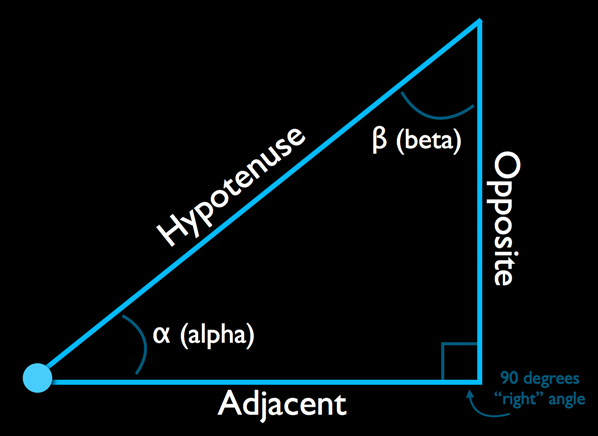
In the picture above, the slanted side is called the hypotenuse. It always sits across from the corner with the 90-degree angle (also called a right angle), and it is always the longest of the three sides.
The two remaining sides are called the adjacent and the opposite, as seen from one particular corner of the triangle, the bottom-left corner in this case.
If you look at the triangle from the other corner (top-right), then the adjacent and opposite change places:
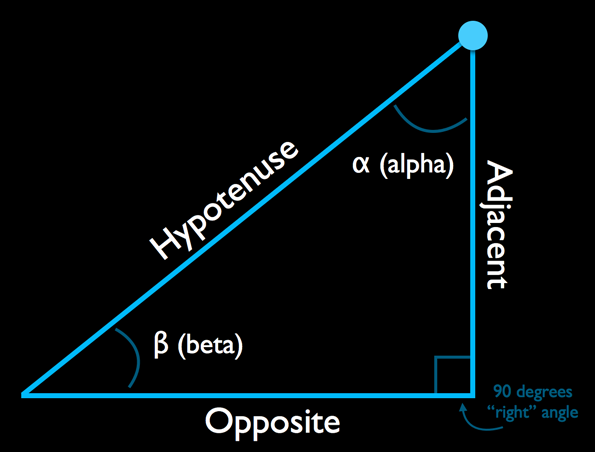
Alpha (α) and beta (β) are the names of the two other angles. You can call these angles anything you want (as long as it sounds Greek!) but usually alpha is the angle in the corner of interest and beta is the angle in the opposing corner. In other words, you label your opposite and adjacent sides with respect to alpha.
The cool thing is that if you only know two of these things, trig allows you to find out all the others using the sine, cosine and tangent functions. For example, if you know an angle and the length of one of the sides, then the sine, cosine and tangent functions can tell you the length of the other sides:
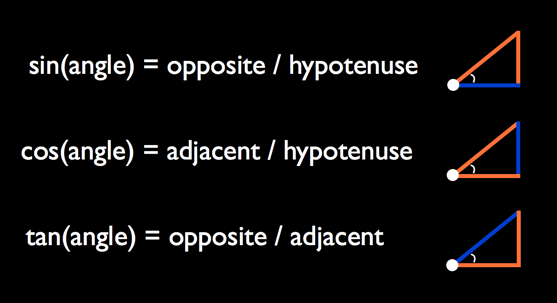
Think of the sin, cos, and tan functions as “black boxes” – you plug in numbers and get back results. They are pre-written functions you can call from almost any programming language.
Know Angle and Length, Need Sides
Let’s consider an example. Say you know the alpha angle between the ships is 45 degrees, and the length between the ships (the hypotenuse) is 10 points long. You can then plug these values into the formula:
sin(45) = opposite / 10
To solve this for the hypotenuse, you shift things around a bit:
opposite = sin(45) * 10
If you call the built-in sin function, you’ll find the sine of 45 degrees is 0.707 (rounded off), and filling that in that gives you the result:
opposite = 0.707 * 10 = 7.07
There is a handy mnemonic for remembering what these functions do that you may remember from high school: SOH-CAH-TOA (where SOH stands for Sine is Opposite over Hypotenuse, and so on), or if you need something more catchy: Some Old Hippy / Caught Another Hippy / Tripping On Acid. (That hippy was probably a mathematician who did a little too much trig.) :]